


Foam Rolling for Bunion Compensation Pain: Releasing the Tight Muscles Behind Your Discomfort
Bunion pain doesn't stay in the bunion. The compensatory gait patterns you adopt to avoid big toe pain — shifting weight, shortening stride, walking on the outer foot edge — create secondary tightness and pain throughout your lower leg and hip. Foam rolling these compensation muscles is one of the most effective and under-utilized adjuncts to bunion management.
Why Bunions Create Muscular Compensation
When push-off through the big toe becomes painful, your body finds workarounds. Each workaround recruits different muscles abnormally:
- Reduced big toe push-off → overworked calves: The gastrocnemius and soleus compensate for reduced toe contribution in propulsion — accumulating chronic tightness
- Lateral weight shift → overworked peroneals: The peroneal muscles on the outer lower leg work harder to stabilize the ankle during lateral loading
- Shortened stride → tight hip flexors: Reduced push-off shortens stride length, increasing hip flexor demand during swing phase
- Toe gripping for stability → overworked foot intrinsics and plantar fascia: Gripping the ground with toes is a common balance compensation that overtaxes the plantar structures
Foam Rolling Protocol for Bunion Patients
1. Calf Complex (Gastrocnemius + Soleus) — 3 min each side
Sit on the floor with the foam roller under your lower leg. Cross the opposite leg over for added pressure. Slowly roll from the back of the knee to the ankle, pausing 5-10 seconds on tender spots. Rotate foot inward and outward to hit different calf fibers.
2. Peroneals (Outer Lower Leg) — 2 min each side
Lie on your side with the roller under the outer aspect of your lower leg. Support yourself on your forearm. Roll from just below the knee to the ankle. This is often surprisingly tender in bunion patients — go slowly.
3. Plantar Fascia and Arch — 2 min each side
Use a lacrosse ball or firm massage ball rather than a foam roller. Stand (or sit for less pressure) and roll the arch of the foot from heel to just behind the toes. Avoid rolling directly over the bunion itself — work the arch and ball of foot around it.
Readers who found this guide helpful are also checking these out — used by 1,800+ customers managing bunion pain at home:

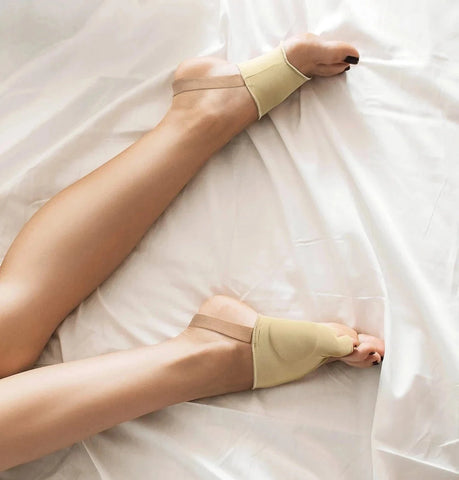
What customers are saying
“The biggest win for me is the pain relief. I used to have this constant ache around the bunion area, especially after a long day on my feet. With the sleeve on, that pain has significantly toned down. I won't say it's a miracle cure, but it's definitely given me some much-needed comfort.”
“My right foot had been bothering me for months — shoes that were always comfortable suddenly hurt after a long day. I’ve been wearing these sleeves for three weeks now and my foot feels mostly back to normal. And the shipping was incredibly fast.”
4. IT Band and Lateral Hip — 3 min each side
Lie on your side with the roller under the outer thigh. Roll from the hip to just above the knee. The IT band itself doesn't release (it's a tough band of fascia) but rolling relaxes the TFL muscle above it that feeds tension into it.
5. Hip Flexors (TFL/Rectus Femoris) — 2 min each side
Lie face-down with the roller under the front of one hip. Slowly roll along the upper thigh/hip flexor. Tight hip flexors are particularly common in bunion patients who walk with an antalgic (pain-avoiding) gait pattern.
Timing and Frequency
- Best time: After the day's activity — muscles are warm and most responsive. Many bunion patients find foam rolling in the evening before bed provides overnight relief.
- Frequency: Daily rolling for compensation muscles during active bunion management; 4-5x/week for maintenance
- Duration: A full session takes 15-20 minutes — significant benefit for a small time investment
Important Cautions
- Never foam roll directly over the bunion bump — the inflamed bursitis won't benefit and you risk further irritation
- Avoid rolling directly over the lumbar spine
- If an area feels neurologically painful (burning, electric, radiating) rather than muscular (dull, pressure), stop — this may indicate nerve involvement that needs evaluation
Foam rolling is free, requires no prescription, and takes minutes. If you've been only treating the bunion locally while ignoring the tight, overcompensating muscles above it, you're managing half the problem. Address the whole kinetic chain.