


Bunion and Knee Pain: How Your Feet Affect Your Knees
If you have bunion pain AND knee pain on the same side, they may not be two separate problems. The kinetic chain that connects your foot to your knee means that bunion deformity can directly cause or worsen knee issues — and vice versa.
The Kinetic Chain Explained
Your body moves as a connected chain from ground up: foot → ankle → shin → knee → hip → spine. Dysfunction at any link affects every joint above and below it. When a bunion changes your foot mechanics, the knee is the first major joint to absorb the consequences.
How Bunions Cause Knee Pain
Overpronation → Knee Valgus
Bunions are associated with overpronation (inward rolling of the foot). When the foot overpronates, the tibia (shinbone) internally rotates. This rotation forces the knee into a valgus position (knock-kneed), increasing stress on:
- The medial (inner) compartment of the knee
- The medial collateral ligament (MCL)
- The patellofemoral joint (kneecap tracking)
Patellofemoral Pain Syndrome
Tibial internal rotation from foot overpronation causes the kneecap to track laterally (pull outward) during bending. This maltracking creates anterior knee pain, patellar grinding, and sometimes crepitus (crunching sensation). Studies show that foot orthotic correction reduces patellofemoral pain by 25-40%.
Compensatory Gait
When bunion pain causes you to walk abnormally — avoiding push-off, shuffling, or favoring the outside of the foot — the knee joint absorbs forces it wasn't designed for. Over months and years, this accelerates cartilage wear and can contribute to knee osteoarthritis.
The Research
- A study in Arthritis Care & Research found that hallux valgus was significantly associated with medial compartment knee osteoarthritis
- Patients with bunions had 2x higher rates of knee pain compared to age-matched controls
- Correcting foot pronation with orthotics reduced knee loading by 10-15% in biomechanical studies
Readers who found this guide helpful are also checking these out — used by 1,800+ customers managing bunion pain at home:

What customers are saying
“The biggest win for me is the pain relief. I used to have this constant ache around the bunion area, especially after a long day on my feet. With the sleeve on, that pain has significantly toned down. I won't say it's a miracle cure, but it's definitely given me some much-needed comfort.”
“My right foot had been bothering me for months — shoes that were always comfortable suddenly hurt after a long day. I’ve been wearing these sleeves for three weeks now and my foot feels mostly back to normal. And the shipping was incredibly fast.”
Integrated Treatment: Foot and Knee Together
Bottom-Up Approach (Starting at the Foot)
- Custom orthotics with medial posting: Control overpronation at the source — this is the most evidence-supported intervention for reducing knee stress caused by foot mechanics
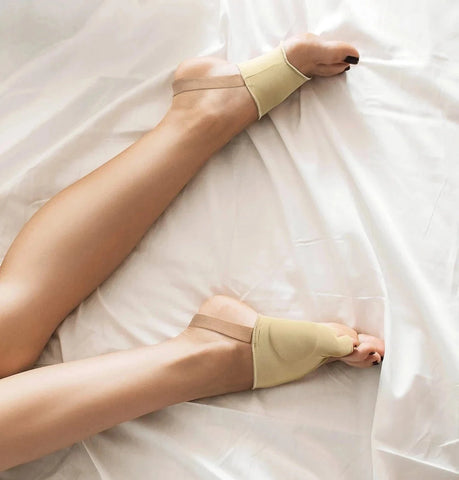
- Bunion sleeves: Allow normal push-off by reducing pain, preventing the compensatory gait that stresses the knee
- Motion control shoes: Built-in stability features resist pronation
Strengthening the Chain
- Hip abductor strengthening: Clamshells, lateral band walks — strong hip abductors resist knee valgus from above
- VMO strengthening: Targeted inner quad exercises — wall sits, terminal knee extensions — improve patellar tracking
- Foot intrinsic exercises: Short foot exercise, toe yoga — provide dynamic arch support from below
- Single-leg balance: Trains the entire kinetic chain to work in alignment
What Doesn't Work
- Treating knee pain with knee braces alone while ignoring the foot — addresses symptoms, not the cause
- Knee surgery without correcting foot mechanics — the same forces will continue
- Generic shoe inserts — they need to specifically address your pronation pattern
When to Seek Help
See both a podiatrist AND an orthopedic specialist or physical therapist if:
- You have bunion pain and knee pain on the same side
- Knee pain worsens with walking or stairs
- Your shoe wear pattern shows excessive inner-edge wear
- You notice your knee "collapses inward" during squats or walking
The Bigger Picture
Your body is a kinetic chain, and your feet are the foundation. A bunion isn't just a foot problem — it's a problem that can cascade up through your ankle, knee, hip, and even your lower back. Treating the bunion and correcting foot mechanics can have surprisingly positive effects on knee pain, hip alignment, and overall mobility.