


Pilates for Bunion Rehabilitation: Core and Foot Alignment Exercises
Pilates has an underappreciated role in bunion rehabilitation. Its emphasis on precise alignment, balanced muscle activation, and optimal movement patterns directly addresses the biomechanical contributors to bunion deformity and compensatory pain. This guide covers Pilates-based exercises specifically adapted for bunion management.
Why Pilates Principles Apply to Bunions
- Whole-body alignment: Pilates works from the center outward — correcting pelvic and hip alignment that affects how load travels through the knee to the foot
- Intrinsic muscle activation: Core Pilates method emphasizes small, deep stabilizing muscles — translating to the small intrinsic foot muscles that resist bunion deformity when trained
- Mind-body awareness: Pilates teaches you to feel and correct compensatory patterns — invaluable for bunion patients who have developed habitual avoidance gait
- Low impact: Mat and reformer Pilates can be done with minimal bunion stress, making it ideal during painful periods
Mat Pilates Exercises for Bunion Management
1. Foot Series (Spine Alignment Baseline)
Lying on your back, knees bent, feet hip-width apart on the mat in "Pilates stance" (neutral spine, ribs down). This exercise teaches neutral foot placement — the foundation for everything else.
- Feel all four corners of your foot grounded equally — big toe base, little toe base, inner heel, outer heel
- Gently draw the big toe down while fanning the other toes — activate abductor hallucis without curling
- Hold 5 seconds, release. 10 repetitions each foot.
2. Heel Slides with Foot Alignment
Lying on back, one leg extended sliding the heel slowly along the mat. Focus on maintaining foot alignment throughout:
- As the leg extends, press the inner heel down — prevents foot from falling outward
- As the leg returns, press the big toe ball into the mat — activates abductor hallucis
- 10 repetitions each side
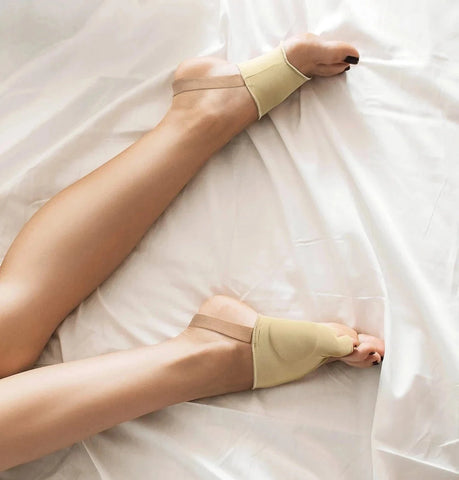
Readers who found this guide helpful are also checking these out — used by 1,800+ customers managing bunion pain at home:

What customers are saying
“The biggest win for me is the pain relief. I used to have this constant ache around the bunion area, especially after a long day on my feet. With the sleeve on, that pain has significantly toned down. I won't say it's a miracle cure, but it's definitely given me some much-needed comfort.”
“My right foot had been bothering me for months — shoes that were always comfortable suddenly hurt after a long day. I’ve been wearing these sleeves for three weeks now and my foot feels mostly back to normal. And the shipping was incredibly fast.”
3. Standing Footwork (Reformer or Against Wall)
Stand with heels on a foam roller or folded towel (heel elevated slightly to reduce big toe dorsiflexion demand):
- Rise through the entire foot — heel raise — while maintaining even toe contact
- Lower slowly through the forefoot without letting the big toe collapse inward
- 15 repetitions
4. The Hundred (Modified)
Classic Pilates hundred with feet in tabletop (knee at 90° over hip) rather than extended low — reduces forefoot loading while working the core:
- Pump arms while maintaining stable pelvis and neutral lumbar spine
- Deep core activation takes load off the lower limbs during the exercise
5. Bridge with Foot Exercise
In bridge position (hips lifted), focus on the feet:
- Phase 1: Press all metatarsal heads equally into the mat at the top of the bridge
- Phase 2: Peel down vertebra by vertebra, rolling through the foot from heel to toe — the big toe is last to leave the mat, activating intrinsics throughout the movement
- 10 controlled repetitions
Reformer-Specific Work
If you have access to a Pilates reformer with an instructor:
- Footwork series: Heels, parallel, V-position, and wraps — each position strengthens different foot stabilizers. Inform your instructor of your bunion so they can modify toe positions that stress the first MTP joint.
- Leg circles: Develops hip rotator strength that reduces lower limb valgus stress at the foot
- Tendon stretch: Excellent for calf-arch complex flexibility — reduces compensatory tightness
Working with an Instructor
Ideally, work with a Pilates instructor who has experience with foot pathology. Show them this guide, explain your bunion deformity, and let them customize your session. Even 6-8 sessions establishes the movement patterns you can then maintain at home.
Pilates doesn't cure bunions — but it builds the whole-body foundation of alignment, strength, and awareness that makes every other bunion intervention work better.