


Corns and Calluses Alongside Bunions: Causes, Care, and When to See a Podiatrist
Corns and calluses are among the most common secondary complications of bunion deformity — and they're often more immediately painful than the bunion itself. Understanding why they form and how to manage them safely protects your skin while you address the underlying bunion.
Why Bunions Cause Corns and Calluses
Bunion deformity redistributes pressure in two ways:
- Direct pressure on the bump: The protruding medial metatarsal head rubs against shoe uppers — creating a callus or corn directly over the bunion prominence
- Pressure redistribution to lesser metatarsals: When the big toe joint is painful, you compensate by shifting weight laterally — pushing more load through the second, third, and fourth metatarsal heads, creating transfer metatarsalgia and calluses under those heads
Angular deformity also causes the second toe to be compressed against the shoe top (hammertoe development) or pressed upon by the displaced big toe — creating interdigital corns between the first and second toes, and dorsal corns on the second toe.
Identifying What You Have
| Type | Appearance | Location | Pain |
|---|---|---|---|
| Callus | Diffuse thickened skin, yellowish, no clear center | Ball of foot, bunion bump | Dull ache under pressure |
| Hard corn (heloma durum) | Circular, hard center ("nucleus"), defined edges | Top of toes, bunion bump | Sharp when pressed |
| Soft corn (heloma molle) | White, macerated, soggy-looking | Between toes (especially 1st-2nd web) | Intense burning |
| Intractable plantar keratosis | Deep, discrete callus plug under a metatarsal head | Ball of foot under 2nd-4th metatarsals | Like stepping on a pebble |
Readers who found this guide helpful are also checking these out — used by 1,800+ customers managing bunion pain at home:

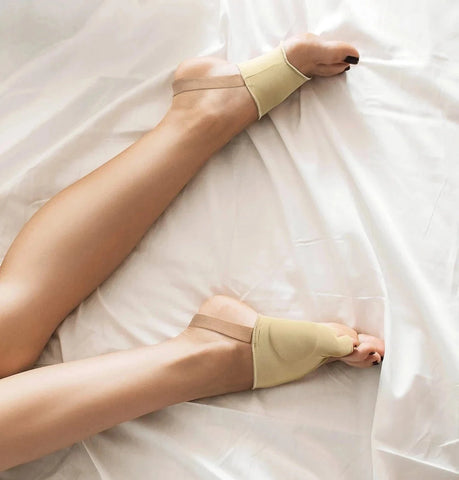
What customers are saying
“The biggest win for me is the pain relief. I used to have this constant ache around the bunion area, especially after a long day on my feet. With the sleeve on, that pain has significantly toned down. I won't say it's a miracle cure, but it's definitely given me some much-needed comfort.”
“My right foot had been bothering me for months — shoes that were always comfortable suddenly hurt after a long day. I’ve been wearing these sleeves for three weeks now and my foot feels mostly back to normal. And the shipping was incredibly fast.”
Safe Home Care
Calluses and Hard Corns (Non-Diabetic Patients)
- Soak foot in warm water for 15 minutes to soften
- Gently use a pumice stone or callus file on softened skin — one direction, no aggressive rasping
- Apply 10-15% urea cream or 17% salicylic acid gel to chemically soften remaining hardened tissue
- Cover with a callus pad (donut pad) to redistribute pressure off the area
- Repeat weekly maintenance — don't try to eliminate the callus in one session
Soft Corns
- Keep the web space dry — soft corns thrive in moisture
- Separate the first and second toe with a soft foam toe separator or lamb's wool
- Apply salicylic acid carefully, avoiding surrounding skin
When to See a Podiatrist
- Immediately if you're diabetic — never self-treat lesions on a diabetic foot
- Any corn or callus with bleeding, discharge, or surrounding redness
- Painful lesions that don't respond to 4 weeks of home care
- Recurrent corns in the same spot despite footwear changes — usually indicates structural problem requiring orthotics
- Deep plantar keratoses that are severely painful during walking
Professional podiatric debridement (sterile scalpel removal) is quick, nearly pain-free, and provides immediate relief. Combine it with addressing the underlying pressure redistribution from the bunion — otherwise the corn returns within weeks.