


Children's Foot Development: When to Worry About Juvenile Bunion Precursors
Most parents don't think about bunions in children. But juvenile hallux valgus affects an estimated 2-4% of children, and the precursor signs often appear years before a visible bump develops. Early detection and intervention can prevent a childhood bunion from becoming a lifelong problem.
Normal Foot Development Timeline
- Birth-2 years: Feet are mostly cartilage. Flat feet are normal. No arch visible.
- 3-5 years: Arch begins to develop. Bones start ossifying (hardening from cartilage to bone).
- 6-8 years: Arch is usually established. Walking gait matures. Most growth plate centers are active.
- 9-12 years: Critical period — rapid foot growth. Bunion precursors often become visible.
- 13-16 years: Growth plates begin closing. Foot structure approaches adult form.
- 17-20 years: Growth plates fully close. Foot structure is final.
Early Warning Signs to Watch For
In Preschoolers (3-5)
- Persistent flat feet: While flat feet at this age can be normal, combined with a family history of bunions, it's a red flag
- Excessive intoeing or outtoeing: Rotational abnormalities that affect forefoot loading
- Shoe wear patterns: Excessive wear on the inner edge of shoe soles
In School-Age Children (6-10)
- Big toe angling toward second toe: Even a subtle angle is significant at this age
- Small bump on inner foot: At the base of the big toe — may be visible when standing
- Complaints of foot tiredness: Children rarely complain about foot pain directly — "my feet are tired" is their equivalent
- Avoiding sports or play: Reluctance to run, jump, or participate may indicate foot discomfort
In Pre-Teens and Teens (11-16)
- Visible bunion bump: Clear bony prominence medially
- Big toe crossing over or under second toe: Progressive deformity
- Difficulty fitting into shoes: Needing wider sizes than peers
- Pain during or after sports: Especially sports requiring push-off (running, basketball, soccer)
Risk Factors in Children
- Family history: The strongest predictor — if one or both parents have bunions, monitor closely
- Flat feet / overpronation: Biomechanical precursor to bunion development
- Hypermobility / joint laxity: Loose ligaments allow greater metatarsal shift
- Female sex: Girls develop juvenile bunions more frequently, possibly due to shoe choices
- Dance training: Ballet in particular (see our ballet & bunions article)
Readers who found this guide helpful are also checking these out — used by 1,800+ customers managing bunion pain at home:

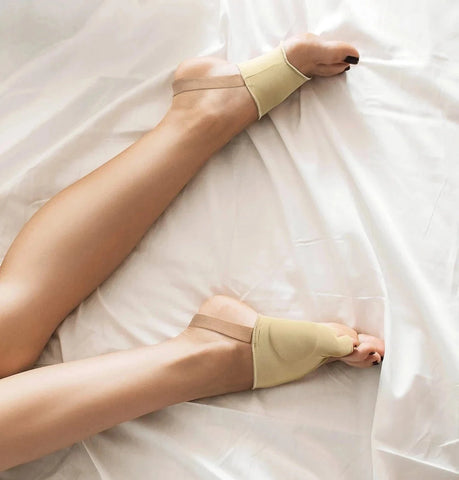
What customers are saying
“The biggest win for me is the pain relief. I used to have this constant ache around the bunion area, especially after a long day on my feet. With the sleeve on, that pain has significantly toned down. I won't say it's a miracle cure, but it's definitely given me some much-needed comfort.”
“My right foot had been bothering me for months — shoes that were always comfortable suddenly hurt after a long day. I’ve been wearing these sleeves for three weeks now and my foot feels mostly back to normal. And the shipping was incredibly fast.”
What Parents Can Do
Footwear Rules
- Always properly size children's shoes: Have feet measured every 3-4 months during growth spurts
- Thumb-width of space between longest toe and shoe end
- Wide toe box: Children's toes should be able to wiggle freely
- No hand-me-down shoes: Worn shoes are molded to another child's foot shape and can force malalignment
- Limit pointy-toe styles: Even in children's shoes, some styles have narrow toe boxes
- Encourage barefoot time: On safe surfaces, barefoot walking strengthens intrinsic foot muscles
When to See a Podiatrist
- Any visible bump at the base of the big toe
- Big toe noticeably angling toward the second toe
- Persistent foot pain or fatigue complaints
- Flat feet that haven't developed an arch by age 6-7
- Family history of bunions combined with ANY of the above
Treatment Options for Children
Conservative (First Line)
- Proper footwear: Wide, supportive shoes — the most important single intervention
- Custom orthotics: Control pronation and redistribute forefoot pressure. Children's orthotics need regular replacement as feet grow.
- Foot strengthening exercises: Toe curls, marble pickups, towel scrunches — made into games for younger children
- Night splints: Some pediatric podiatrists recommend gentle night splinting for mild cases
- Bunion sleeves: Soft, cushioning protection for active children
Surgical (Rare in Children)
Surgery for juvenile bunions is approached with extreme caution because of open growth plates:
- Most surgeons prefer to delay surgery until growth plates close (typically 14-16 for girls, 16-18 for boys)
- Operating through open growth plates risks growth disturbance and angular deformity
- Some specialized pediatric procedures can be performed earlier in severe cases
- Recurrence rate is higher in children than adults because growth continues after correction
Early awareness is the best medicine for juvenile bunions. If your child has risk factors, start monitoring now — and bring concerns to a pediatric podiatrist sooner rather than later. The interventions are simple and non-invasive when caught early.