


Ballet and Bunions: Why Dancers Are at High Risk and How to Protect Your Feet
Bunions are so prevalent in ballet that many dancers consider them an occupational inevitability. Studies show that up to 71% of professional ballet dancers develop hallux valgus, compared to roughly 23% of the general population. But bunions don't have to end your dance career — or even slow it down.
Why Ballet Creates Bunions
Pointe Work
Dancing en pointe concentrates the entire body's weight on the tips of the toes. The first metatarsophalangeal joint sustains enormous compressive and shearing forces. Over thousands of hours of training, these forces can gradually push the big toe laterally while the metatarsal drifts medially — classic bunion formation.
Forced Turnout
Classical ballet demands 180° external rotation of the legs. When hip external rotation is insufficient, dancers compensate by "screwing the knee" — forcing turnout from the foot. This pronatory force through the foot directly stresses the first MTP joint and promotes bunion development.
Pointe Shoe Fit
Pointe shoes are by nature narrow and rigid. Improperly fitted shoes — particularly those that are too narrow or too tapered in the box — compress the forefoot in exactly the way that drives bunion formation.
Training Volume
Professional dancers train 6-8 hours daily, beginning in childhood. The cumulative microtrauma over 10-20+ years of intensive training overwhelms the joint's capacity to adapt.
Genetics vs. Training
The debate continues: are dancers' bunions caused by ballet, or do genetically predisposed individuals develop bunions faster because of ballet? The answer is likely both:
- Dancers with family history develop bunions earlier and more severely
- Dancers WITHOUT family history still develop bunions at higher rates than non-dancers
- Foot structure matters: Egyptian foot type (long first toe) is at highest risk during pointe work
Readers who found this guide helpful are also checking these out — used by 1,800+ customers managing bunion pain at home:

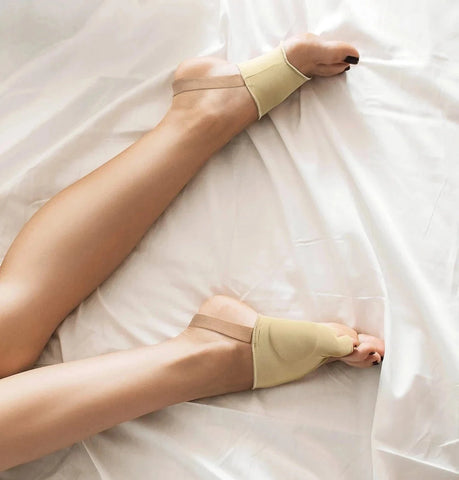
What customers are saying
“The biggest win for me is the pain relief. I used to have this constant ache around the bunion area, especially after a long day on my feet. With the sleeve on, that pain has significantly toned down. I won't say it's a miracle cure, but it's definitely given me some much-needed comfort.”
“My right foot had been bothering me for months — shoes that were always comfortable suddenly hurt after a long day. I’ve been wearing these sleeves for three weeks now and my foot feels mostly back to normal. And the shipping was incredibly fast.”
Prevention Strategies for Active Dancers
Pointe Shoe Fitting
- Work with a specialized pointe shoe fitter who understands bunion accommodation
- Choose a box shape that matches your foot — square box for wide forefoot, tapered for narrow
- Consider brands with wider vamp options (Gaynor Minden, Bloch Heritage, Russian Pointe)
- Replace pointe shoes frequently — broken-down shoes provide no structural support
Technique Corrections
- Develop hip external rotation: Improve turnout from the hip, not the foot — reduces compensatory pronation
- Weight distribution: Distribute weight evenly across all metatarsal heads when en pointe — avoid "sinking" into the big toe
- Rising through demi-pointe: Strengthen the push-through phase to reduce sudden joint loading
Off-Stage Foot Care
- Wear bunion sleeves during class (not pointe, but flat and contemporary work)
- Use toe spacers between big and second toe when not dancing
- Strengthen intrinsic foot muscles with towel scrunches, marble pickups, and theraband exercises
- Ice after intense rehearsals — 15 minutes on, 15 off
- Stretch calves and plantar fascia daily
Dancing with an Existing Bunion
- Silicone bunion guards: Thin pads inside pointe shoes protect the bump from box pressure
- Custom pointe shoe modifications: Some fitters can stretch the medial box to accommodate the bunion
- Taping: Athletic tape supporting the big toe in alignment during class
- Pain monitoring: Sharp, worsening pain means you're doing damage — modify activity immediately
When Surgery Becomes Necessary
For professional dancers, surgery timing is critical:
- Many dancers postpone surgery until retirement from performance
- Recovery takes 3-6 months for daily activities, 6-12 months for return to pointe
- Some dancers successfully return to full performance after surgery — but outcomes vary
- Discuss expectations with BOTH your surgeon and your artistic director
A bunion doesn't have to be the final curtain call. Proactive foot care, proper pointe shoe selection, and technique refinement can keep you dancing beautifully — while protecting the feet that make it all possible.