


How Heel-to-Toe Drop in Shoes Affects Bunion Pain: A Podiatrist's Guide
Last updated: March 2026 | Written by: Dr. Emily Hart, DPM – Biomechanics and Foot Health Specialist
When shopping for bunion-friendly shoes, most people focus on toe box width. But there's another critical spec that dramatically affects bunion pain: heel-to-toe drop. This measurement — the height difference between the heel and forefoot of a shoe — determines how much pressure is placed on your bunion joint with every step.
What Is Heel-to-Toe Drop?
Heel-to-toe drop (also called "shoe drop") is measured in millimeters:
- Zero drop (0mm): Heel and forefoot are at the same height (e.g., Altra, Vivobarefoot)
- Low drop (1-4mm): Minimal height difference (e.g., New Balance Minimus)
- Moderate drop (5-8mm): Balanced cushioning (e.g., Brooks Ghost, Hoka Bondi)
- High drop (9-12+mm): Traditional running shoes (e.g., Nike Pegasus, ASICS Gel-Kayano)
How Does Drop Affect Bunion Pain?
High-Drop Shoes (9-12mm): More Forefoot Pressure
Shoes with a high heel-to-toe drop tilt your foot forward, shifting weight onto the forefoot. For bunion sufferers, this means increased pressure directly on the first metatarsophalangeal (MTP) joint — exactly where your bunion is. Studies show that a 12mm drop shoe increases forefoot loading by approximately 20-25% compared to a zero-drop shoe.
Zero-Drop Shoes (0mm): Natural but Challenging
Zero-drop shoes place your foot in a natural, flat position that theoretically distributes weight more evenly. However, if you've been wearing traditional shoes your entire life, switching to zero-drop cold turkey can cause Achilles tendon strain, calf soreness, and plantar fasciitis as your posterior chain adapts. For bunion patients, the transition must be gradual.
The Sweet Spot: 4-6mm Drop
For most bunion patients, a 4-6mm drop provides the ideal balance:
- Low enough to reduce excessive forefoot loading
- High enough to provide some heel cushioning for comfort
- Compatible with most orthotics and bunion sleeves
- Doesn't require a long adaptation period
Best Shoe Drop Recommendations by Activity
| Activity | Recommended Drop | Why |
|---|---|---|
| Walking | 4-6mm | Balanced support without forefoot overload |
| Running | 4-8mm | Some cushion for impact; wide toe box essential |
| Standing all day | 4-6mm | Reduces metatarsal fatigue |
| Casual / Home | 0-4mm | Allows natural foot mechanics; pair with sleeve |
Pairing Low-Drop Shoes with Bunion Sleeves
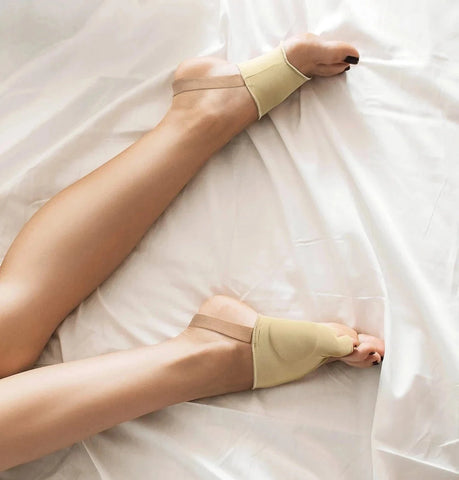
When wearing lower-drop shoes, an orthopedic bunion sleeve provides the extra forefoot padding and toe alignment support that the shoe's reduced structure may lack. The gentle compression also helps reduce inflammation during activity.
Recommended Products for Bunion Relief
Shop the HalluxCare Orthopedic Bunion Sleeve →

How to Transition to Lower-Drop Shoes Safely
- Week 1-2: Wear lower-drop shoes for 30 minutes daily while doing light activities
- Week 3-4: Increase to 1-2 hours; do calf stretches morning and evening
- Week 5-8: Wear for half the day; alternate with your regular shoes
- Week 9+: Full-day wear; your Achilles and calf muscles should be adapted
Important: If you experience calf pain, heel pain, or Achilles tenderness, slow down the transition.
Key Takeaways
- Heel-to-toe drop significantly affects how much pressure is placed on your bunion
- High-drop shoes (9-12mm) increase forefoot loading and can worsen bunion pain
- A 4-6mm drop is the sweet spot for most bunion sufferers
- Transition to lower-drop shoes gradually over 8+ weeks
- Pair lower-drop shoes with an orthopedic bunion sleeve for optimal relief
Readers who found this guide helpful are also checking these out — used by 1,800+ customers managing bunion pain at home:
What customers are saying
“The biggest win for me is the pain relief. I used to have this constant ache around the bunion area, especially after a long day on my feet. With the sleeve on, that pain has significantly toned down. I won't say it's a miracle cure, but it's definitely given me some much-needed comfort.”
“My right foot had been bothering me for months — shoes that were always comfortable suddenly hurt after a long day. I’ve been wearing these sleeves for three weeks now and my foot feels mostly back to normal. And the shipping was incredibly fast.”