


Bunion Pain After Standing All Day: Relief Strategies for Retail and Service Workers
If your job keeps you on your feet for 8-12 hours, your bunion is taking a beating that desk workers can't imagine. The average retail or restaurant worker takes 15,000-20,000 steps per shift on hard surfaces. Here's how to survive — and thrive — on your feet all day without your bunion dictating your career.
Why Standing Jobs Hit Bunions Harder
- Cumulative loading: 8+ hours of continuous weight-bearing overwhelms the MTP joint's capacity to manage stress
- Hard surfaces: Concrete, tile, and hardwood floors offer zero shock absorption — every step transmits full impact to the bunion
- End-of-shift swelling: Feet can swell a full shoe size by hour 8. Shoes that fit in the morning compress the bunion by afternoon.
- Limited break time: You can't ice, elevate, or change shoes mid-shift in most jobs
- Uniform shoe requirements: Some employers mandate specific footwear that may not accommodate bunions
Pre-Shift Preparation
- Apply bunion sleeve: Put it on BEFORE your shift, not when pain starts. Prevention > treatment.
- Wear moisture-wicking socks: Merino wool or synthetic blend — NOT cotton. Wet socks increase friction on the bunion.
- Lace shoes properly: Use the "bunion lacing" technique — skip the eyelet nearest the bunion to create a pressure-free zone over the bump.
- Anti-friction balm: Apply to the bunion and between toes to reduce hot spots
During Your Shift
Micro-Breaks (Even 60 Seconds Helps)
- Toe lifts: While standing at the register or counter, lift all toes off the ground, hold 5 seconds, release. Repeat 10 times. Activates intrinsic muscles and relieves forefoot compression.
- Weight shifting: Rock from heels to toes slowly every 15-20 minutes. Varies the loading pattern on the forefoot.
- Calf raises: Rise onto your toes (gently!) for 3 seconds, lower slowly. 10 reps. Promotes circulation and reduces swelling.
- One-foot rest: If there's a low shelf or box, rest one foot on it for 30 seconds. Alternating reduces total standing load by 50% on each foot.
Anti-Fatigue Mats
If you have a fixed station (cash register, hostess stand, prep station), request an anti-fatigue mat. These cushioned mats reduce forefoot impact by 30-50% and are an easy accommodation request most employers will approve.
Readers who found this guide helpful are also checking these out — used by 1,800+ customers managing bunion pain at home:

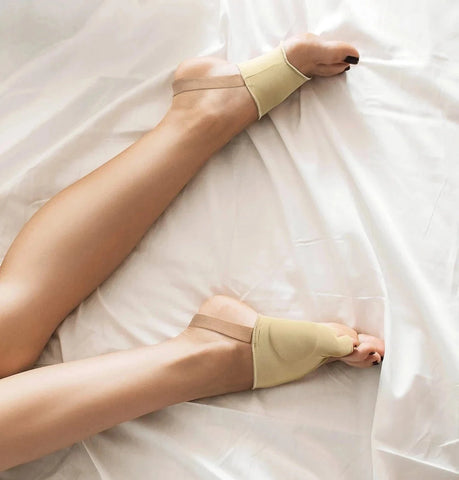
What customers are saying
“The biggest win for me is the pain relief. I used to have this constant ache around the bunion area, especially after a long day on my feet. With the sleeve on, that pain has significantly toned down. I won't say it's a miracle cure, but it's definitely given me some much-needed comfort.”
“My right foot had been bothering me for months — shoes that were always comfortable suddenly hurt after a long day. I’ve been wearing these sleeves for three weeks now and my foot feels mostly back to normal. And the shipping was incredibly fast.”
Post-Shift Recovery Protocol
Immediately After Work
- Remove shoes and socks: let your feet breathe and decompress
- Ice the bunion: 15-20 minutes with a cloth barrier. Frozen water bottle rolling under the arch does double duty — ices and massages.
- Elevate: Feet above heart level for 15-20 minutes. Lie on couch with feet on the back cushion.
Evening Recovery
- Epsom salt soak: Warm water with 1-2 cups Epsom salt for 15-20 minutes. Reduces swelling and soothes muscle fatigue.
- Foot massage: Tennis ball under the arch, rolling back and forth. Focus on the plantar fascia and intrinsic muscles.
- Toe stretches: Interlace your fingers between your toes and gently spread them. Hold 30 seconds per foot.
- Compression socks: Wear graduated compression socks for 2-3 hours after your shift to reduce residual swelling
Best Shoes for Jobs That Require Standing
Key Features
- Wide toe box: Non-negotiable — your bunion needs room
- Cushioned midsole: Energy-return foam (like New Balance FreshFoam or Brooks DNA AMP) absorbs standing impact
- Slip-resistant outsole: Critical for kitchen, hospital, and retail environments
- Removable insole: Lets you add custom orthotics or met pads
Top Picks by Industry
- Restaurant/Kitchen: New Balance 626v2 (wide available, slip-resistant), Dansko Professional (wide toe box, rocker bottom)
- Retail: Brooks Ghost (wide), KEEN Utility (wide, soft toe)
- Healthcare: Hoka Bondi (maximum cushion, wide), Clove shoes (designed for healthcare, easy clean)
Talking to Your Employer
Under the ADA, if your bunion is documented by a physician, you may be entitled to reasonable workplace accommodations:
- Permission to wear specific supportive footwear (even outside dress code)
- Anti-fatigue mat at your workstation
- Scheduled brief sitting breaks (5 minutes per hour)
- Rotation to non-standing tasks when available
Your bunion shouldn't limit your career. With the right gear, habits, and recovery routine, you can manage a standing job comfortably — shift after shift.