


How Flat Feet Cause Bunions: The Overpronation Connection Explained
If you have both flat feet and bunions, it's probably not a coincidence. Research shows that pes planus (flat feet) is one of the strongest biomechanical predictors of hallux valgus development. Here's why these two conditions are linked and what you can do about it.
The Biomechanical Chain Reaction
When your arch collapses during walking (overpronation), a predictable chain reaction occurs:
- Arch collapse: The medial longitudinal arch flattens under body weight
- Heel eversion: The heel rolls inward excessively
- Midfoot instability: The tarsometatarsal (TMT) joints become hypermobile
- First metatarsal drift: The first metatarsal bone shifts medially (inward) away from the others
- Big toe compensation: The big toe angles laterally (toward the second toe) to maintain push-off
- Bunion forms: The metatarsal head protrudes, creating the visible bump
This isn't hypothetical — it's directly observable on weight-bearing X-rays and gait analysis studies.
How Common Is the Connection?
- Studies show 60-70% of bunion patients have some degree of pes planus
- People with moderate-to-severe flat feet are 3-4 times more likely to develop bunions than those with normal arches
- The connection is strongest in patients whose flat feet developed in adulthood (acquired flatfoot)
Self-Assessment: Do You Overpronate?
The Wet Test
Wet your foot and step on a paper bag or dark tile. If the entire footprint is visible (no arch gap), you likely have flat feet. A normal arch shows a distinct narrowing in the midfoot.
Shoe Wear Pattern
Check the soles of your most-worn shoes. Excessive wear on the inner edge of the sole — especially at the ball of the foot — indicates overpronation.
Posterior View
Have someone photograph your heels from behind while standing. If the heels tilt inward (valgus position), your feet are overpronating.
Readers who found this guide helpful are also checking these out — used by 1,800+ customers managing bunion pain at home:

What customers are saying
“The biggest win for me is the pain relief. I used to have this constant ache around the bunion area, especially after a long day on my feet. With the sleeve on, that pain has significantly toned down. I won't say it's a miracle cure, but it's definitely given me some much-needed comfort.”
“My right foot had been bothering me for months — shoes that were always comfortable suddenly hurt after a long day. I’ve been wearing these sleeves for three weeks now and my foot feels mostly back to normal. And the shipping was incredibly fast.”
Treatment: Addressing Both Problems Together
Arch Support (Foundation)
Treating bunions without addressing flat feet is like treating symptoms while ignoring the cause. Options include:
- Custom orthotics: Prescription insoles with medial posting and arch support — the gold standard for controlling overpronation
- Over-the-counter arch supports: Semi-rigid insoles (not soft foam) provide moderate correction
- Motion control shoes: Built-in medial posts and supportive midsoles resist pronation
Foot Strengthening
- Short foot exercise: Strengthens the intrinsic arch muscles — the "active arch support"
- Toe yoga: Big toe presses while lifting other toes — builds abductor hallucis strength
- Calf stretching: Tight calves worsen pronation. Stretch daily.
Bunion Protection
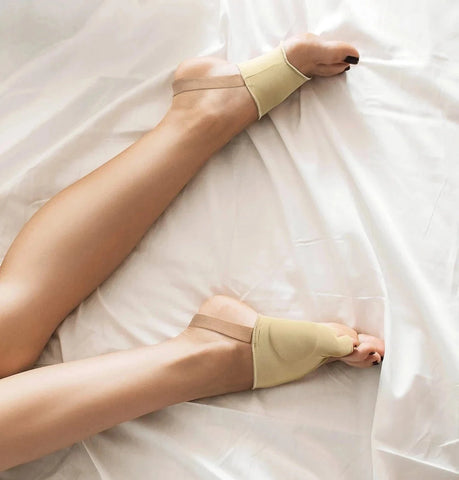
- Medical-grade bunion sleeves provide cushioning and gentle realignment while arch support addresses the root cause
- Wide toe box shoes accommodate both the bunion bump and the orthotic insert
Surgical Implications
If surgery becomes necessary, the flat foot component MUST be addressed. Correcting the bunion without stabilizing the arch often leads to recurrence within 5-10 years. Procedures like Lapiplasty address both the bunion and the underlying metatarsal instability at the TMT joint.
Understanding the flat feet–bunion connection empowers you to treat the root cause, not just the visible bump. Start with proper arch support and strengthening — your bunion management will be far more effective.