


Tennis and Pickleball with Bunions: Court-Specific Foot Care for Racquet Sports
Pickleball is the fastest-growing sport in America — and its quick lateral movements, frequent direction changes, and repeated split-step landings make it a significant challenge for bunion sufferers. Paired with tennis's similar demands, racquet sports require specific adaptations to protect your big toe joint during play.
Why Racquet Sports Are Hard on Bunions
- Lateral cutting: The rapid side-to-side movements in both sports create lateral shear force on the forefoot — the exact force that drives the metatarsal medially and worsens bunion deformity
- Split-step landings: The split-step (anticipatory jump) creates impact loads of 2-3x body weight through the forefoot with the toes in a spread position
- Court surface rigidity: Hard courts (concrete, acrylic) provide no shock absorption compared to natural surfaces
- Frequent direction reversals: Each reversal involves the big toe gripping the court surface and pushing off — multiplied hundreds of times in a single match
Court Shoe Selection
Tennis Shoes with Bunion Accommodation
- Key requirement: lateral stability WITHOUT toe box compression — the shoe must resist the lateral movements without narrowing the forefoot
- Look for herringbone outsoles for traction and a supportive midfoot cage that keeps the arch from rolling without applying forefoot pressure
- Best options: New Balance 806/996 (wide models), ASICS Gel-Resolution Wide, Babolat Propulse (wide sizing)
Pickleball-Specific Shoes
Pickleball shoes have emerged as a category distinct from tennis shoes — typically slightly lighter with adequate lateral support for shorter court dimensions:
- K-Swiss Hypercourt Wide, Skechers Viper Court Wide, and ACACIA Pickleball Shoes offer wider forefoot profiles
- Avoid running shoes on the pickleball court — they lack lateral support and increase ankle sprain risk
Readers who found this guide helpful are also checking these out — used by 1,800+ customers managing bunion pain at home:

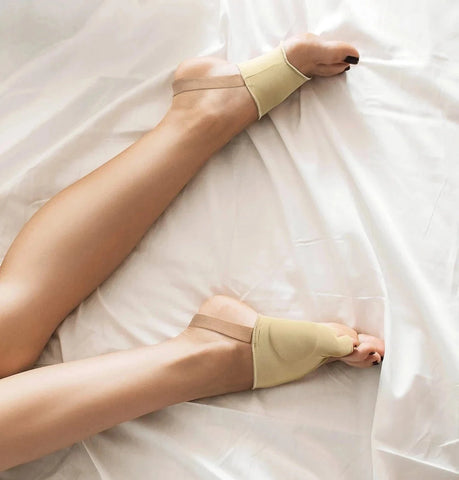
What customers are saying
“The biggest win for me is the pain relief. I used to have this constant ache around the bunion area, especially after a long day on my feet. With the sleeve on, that pain has significantly toned down. I won't say it's a miracle cure, but it's definitely given me some much-needed comfort.”
“My right foot had been bothering me for months — shoes that were always comfortable suddenly hurt after a long day. I’ve been wearing these sleeves for three weeks now and my foot feels mostly back to normal. And the shipping was incredibly fast.”
Pre-Match Bunion Prep
- Bunion sleeve applied before the shoe — padding between shoe and bump
- Anti-friction balm at the bunion and between big toe and second toe
- Big toe range-of-motion exercises: 30 seconds of lateral toe mobilization to warm up the joint
- Calf stretches: Tight calves increase forefoot impact forces
- Lacing adjustment: Use the extra eyelet at the top of the shoe to lock the heel back — prevents the foot sliding forward into the toe box during direction changes
During-Play Pain Management
- On changeovers: briefly remove shoes, spread toes, and do 10 big toe circles each direction
- If bunion pain starts becoming sharp (above 6/10), take a longer break — playing through sharp pain causes damage
- Consider modified singles tactics: position closer to center to reduce running distance per point
Post-Match Recovery
- Ice: 20 minutes on bunion and forefoot after every session
- Contrast soak: Alternating warm/cold foot soak 2x weekly for players who play frequently
- Elevation: 15-20 minutes with legs up after an intense session
- Rest day spacing: With bunions, aim to have at least one complete rest day between court sessions — not three days on, one off
Backcourt vs. Net Play
Baseline rallying involves more running but smaller directional forces per step. Net play involves explosive short bursts with maximum lateral loading — harder on bunions per minute of play. During painful periods, consider staying at the baseline more and playing a retriever style until symptoms calm.
Millions of pickleball and tennis players manage bunions without giving up the game. Smart equipment choices, consistent foot care, and knowing when to dial back intensity keeps you on the court for years to come.