


Running with Bunions: Can You Still Run Safely? A Runner's Complete Guide
The question every runner with a bunion asks: "Do I have to stop running?" In most cases, the answer is no — but you need to run smarter, not just harder. Here's how to keep logging miles while protecting your bunion.
Understanding the Impact on Running
During running, your big toe joint absorbs 2.5-3 times your body weight during push-off — the phase where bunion pain is worst. This repeated stress can aggravate the bunion if your mechanics, shoes, or training load aren't optimized.
Running Shoe Selection for Bunions
Non-Negotiable Features
- Wide toe box: Brands like Altra (foot-shaped design), New Balance (wide options), and Brooks (many come in Wide/2E) offer room for the bunion
- Minimal seams over the bunion area: Engineered mesh with welded overlays (not stitched) reduces friction
- Adequate cushioning: Moderate to high cushioning reduces impact on the big toe joint
- Flexible forefoot: The shoe should bend easily at the ball of the foot — rigid forefoot = more bunion stress
Lacing Techniques
Use a bunion-relief lacing pattern: skip the eyelet closest to the bunion area, creating a gap in lace tension over the bump. This customizes the shoe fit without replacing the shoe.
Running Form Modifications
- Increase cadence: Take shorter, quicker steps. Higher cadence (170-180 steps/min) reduces the force on each push-off
- Land midfoot: Avoid aggressive forefoot striking, which loads the bunion joint early in stance
- Keep feet under hips: Overstriding increases braking forces through the forefoot
- Avoid toe-off push: Think of "lifting" your foot rather than "pushing off" — reduces big toe joint stress
Training Adjustments
- Reduce high-intensity days: Speed work and hill repeats put the most stress on the bunion. Limit to 1-2x per week
- Choose soft surfaces: Trails, grass, and tracks are gentler than concrete and asphalt
- Cross-train strategically: Replace 1-2 running days with cycling or swimming to maintain fitness without forefoot impact
- Build mileage gradually: The 10% rule (increase weekly mileage by no more than 10%) protects bunions from overload
Readers who found this guide helpful are also checking these out — used by 1,800+ customers managing bunion pain at home:

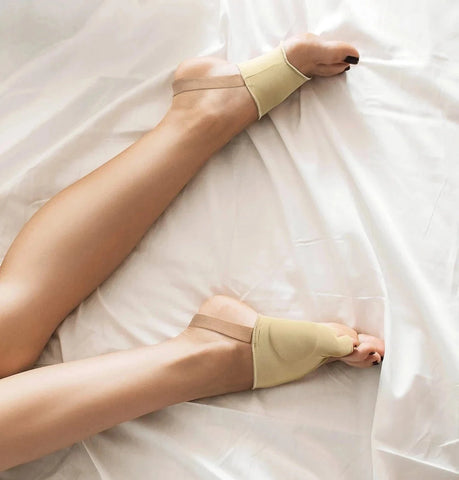
What customers are saying
“The biggest win for me is the pain relief. I used to have this constant ache around the bunion area, especially after a long day on my feet. With the sleeve on, that pain has significantly toned down. I won't say it's a miracle cure, but it's definitely given me some much-needed comfort.”
“My right foot had been bothering me for months — shoes that were always comfortable suddenly hurt after a long day. I’ve been wearing these sleeves for three weeks now and my foot feels mostly back to normal. And the shipping was incredibly fast.”
Pre-Run and Post-Run Bunion Care
Before Running
- Apply a thin bunion sleeve under your running sock for cushioning and alignment support
- 5 minutes of toe mobility exercises: toe spreads, big toe circles, ankle dorsiflexion stretches
- Apply anti-chafe balm to the bunion area to reduce friction
After Running
- Ice the bunion for 15-20 minutes immediately after
- Elevate feet for 10-15 minutes
- Gentle self-massage of foot intrinsics with a lacrosse ball
- Calf stretching — tight calves force more pressure through the forefoot
Warning Signs to Stop Running
- Sharp pain during push-off that alters your gait (limping or favoring the other foot)
- Pain that persists for 2+ hours after running
- Visible redness and swelling that's worse than typical post-run
- Compensatory pain in the opposite foot, knee, or hip (your body is overcompensating)
- Big toe joint can't bend 30° upward — hallux rigidus requires medical attention
Race Day Tips
- Never wear new shoes on race day — break them in for 3-4 training runs minimum
- Apply bunion sleeve and anti-chafe balm before the start
- Start conservatively — first mile excitement can mask bunion stress
- Have a bail-out plan — dropping from a half-marathon to a 10K is smarter than injuring yourself
Many elite and recreational runners successfully compete with bunions. The key is smart shoe selection, form awareness, and listening to your body's signals. Your bunion doesn't end your running — it just requires you to run more intelligently.