


Proprioception and Bunions: Why Your Balance Suffers and How to Restore It
Your big toe joint is one of the most proprioceptively rich structures in the entire foot — packed with mechanoreceptors that continuously send position, pressure, and movement data to your brain. Bunion deformity disrupts these sensors, causing measurable balance impairment that worsens as the deformity progresses.
What Is Proprioception?
Proprioception is the body's ability to sense its own position in space without looking. It relies on mechanoreceptors in muscles, tendons, joints, and skin that detect stretch, compression, and movement — sending this information to the cerebellum and motor cortex to coordinate balance and movement.
How Bunions Impair Proprioception
Joint Deformity Distorts Sensor Signals
The mechanoreceptors in the first MTP joint capsule are calibrated for normal joint geometry. When hallux valgus deformity distorts the joint, the same neural signals no longer correspond to the same positions — creating a kind of "calibration error" in the proprioceptive system.
Chronic Inflammation Impairs Receptor Function
Ongoing bursitis and synovitis flood the joint environment with inflammatory cytokines that impair mechanoreceptor sensitivity — reducing both the accuracy and speed of proprioceptive feedback.
Pain-Avoidance Patterns Disrupt Normal Gait
Avoiding weight on the painful bunion creates asymmetric loading that the balance system isn't designed for — progressively disrupting the automatic, subconscious balance programs that depend on consistent sensory input.
Readers who found this guide helpful are also checking these out — used by 1,800+ customers managing bunion pain at home:

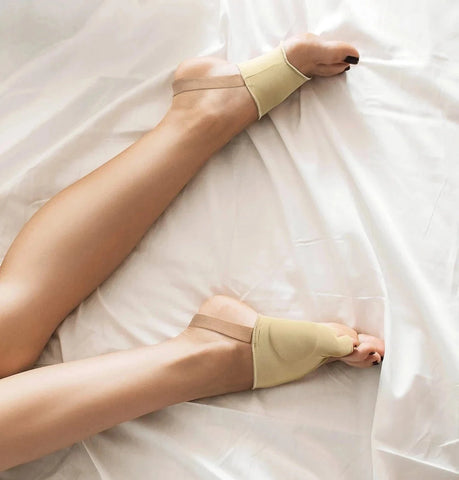
What customers are saying
“The biggest win for me is the pain relief. I used to have this constant ache around the bunion area, especially after a long day on my feet. With the sleeve on, that pain has significantly toned down. I won't say it's a miracle cure, but it's definitely given me some much-needed comfort.”
“My right foot had been bothering me for months — shoes that were always comfortable suddenly hurt after a long day. I’ve been wearing these sleeves for three weeks now and my foot feels mostly back to normal. And the shipping was incredibly fast.”
Research Evidence
- Studies using force plates show bunion patients have significantly greater postural sway than matched controls — both on the affected foot and even the unaffected foot
- Proprioceptive testing (single-leg balance, tandem stance) consistently shows impairment proportional to bunion severity
- Post-bunion surgery patients show proprioceptive improvement — but not full recovery without specific rehabilitation
Proprioceptive Rehabilitation Exercises
Phase 1: Sensory Awareness (Weeks 1-2)
- Barefoot texture walking: Walk slowly barefoot on carpet, then tile, then grass — the varied sensory input reactivates dormant mechanoreceptors throughout the foot. Do 5 minutes per surface, 2x daily.
- Foot pressure mapping: Stand with eyes closed and consciously feel which parts of each foot are in contact with the floor. Practice making weight distribution equal.
Phase 2: Single-Leg Stability (Weeks 3-6)
- Single-leg balance: 30 seconds eyes open → progress to eyes closed → progress to foam pad under foot
- Reach test: Stand on one foot, slowly reach other foot forward, sideways, and backward without touching down — challenges balance system in multiple planes
Phase 3: Dynamic Proprioception (Weeks 7-12)
- Tandem walking (heel-to-toe): Walk in a straight line placing heel directly in front of toes on each step — demands fine proprioceptive coordination
- Step-down training: Step down from a 4-inch step, landing on affected foot, tracking knee-over-second-toe during landing — 3 sets of 10 per leg
Long-Term Maintenance
Even after pain resolution, proprioceptive training should remain a component of foot health maintenance. The sensors, once impaired, benefit from ongoing stimulation. Just 10 minutes of balance exercises 3x weekly maintains significant proprioceptive protection against falls and re-injury.